
The best sensory play ideas for toddlers are cheap, simple to set up, and of course – fun! And of course, everyone knows the benefits of sensory play for toddlers (we listed a few of them in This Is Sensory Play Actually Simplified – One Intervention Centre if you need a recap!) But, we know that it can be a little overwhelming trying to figure out where to start with sensory play.
That’s why ONE Intervention has put together this list of The Best Sensory Play Ideas For Toddlers To Try Now! We’ll include the tangible and intangible benefits of each form of sensory play, as well as briefly go over the amount of preparation needed. This way, you can choose the best form of sensory play for your toddler. Alright, ready? Fantastic! Let’s get into it.
Playdough
Don’t turn your nose down on this classic form of sensory play for toddlers! Playdough has been a reliable play-based learning tool for kids for years, and it’s not leaving anytime soon. This is because messing around with playdough actually improves your child’s fine motor skills – that is, the small muscle groups in their hands and fingers. When they roll and shape the dough, they’re learning more about how to control these muscles and refine the amount of pressure they use with such delicate tasks.
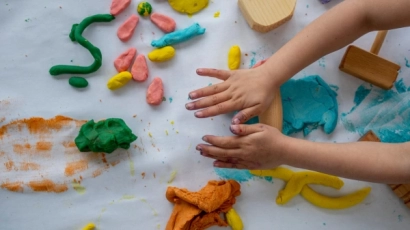
And if you think that playdough is just, well, dough, and you can’t really do anything with it? Well, you couldn’t be further from the truth. Try adding small coloured beads or even uncooked tapioca balls into the dough, then have your children describe the texture. Is it soft? Squishy? Hard, or gritty? Introducing your children to the different textures helps them to further develop their tactile sense, so they can carry out more sensory exploration and investigation.
Take it one step further by challenging the kiddos to find a certain number of beads. For example, ‘Find me 1 red bead, 4 blue beads and 3 purple beads’ is an engaging way to practise your child’s memory skills and sequencing.
Or, you could even knead a few drops of essential oil into the playdough! Lavender, mint and lemon are all great scents. Sensory seeking kids will appreciate that they can engage in both their sense of touch and smell while playing with such playdough, and besides, the scents can be really calming for your hyperactive kids. Just a drop or two will suffice, though! Any more and it could be overpowering for children with a slightly more sensitive nose.
Slime
Have you checked out our article on Sensory Struggles & Beyond: How Slime Can Be Your Child’s Playful Ally – One Intervention Centre? Yeah? Then you’d know exactly how helpful slime is as a form of sensory play for toddlers. It’s easy to make – you probably have all the ingredients lying around at home already. It’s versatile enough to customise it exactly to your child’s liking. And, most importantly, it’s fun!
Take it from us, you can never really run out of sensory play ideas with slime. Don’t be afraid to experiment with different types. Try fluffy slime for an indulgent sensory play experience with toddlers, the texture is so much softer and more stretchy than regular slime! Or, try folding different things into the slime, similar to the idea of adding beads into playdough like we discussed above. Some classics would be small foam balls, or even glitter.
Pro tip: Have your kid chip in and help make the slime with you! Really, slime is laughably easy to make. The base two ingredients are a lot of glue, a tablespoon of baking soda, and a little saline solution – for example, the type that you use to clean contact lenses. None of these are particularly hazardous to children, so long as you’re with them for adult supervision. Have your children stir and knead the slime with you, because this rhythmic motion can be extremely soothing.
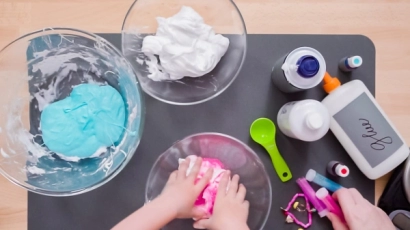
If you want, you can even invite your kid’s friends over to help make the slime. This form of sensory play is pretty popular, so you can be sure that everyone will have a fantastic time!
Kinetic sand
Kinetic sand is pretty much just sand, but with some extra ingredients added to it. The full breakdown and step-by-step recipe can be found in this helpful article by Tinkergarten. But all this is to say that kinetic sand is soft, fluffy and malleable – the perfect sensory play tool for toddlers! Best of all, it can be cleaned up fairly easily, with nothing but warm water and a bit of soap. Unlike real sand, kinetic sand won’t get everywhere, so your children can knead and play with it to their heart’s content.
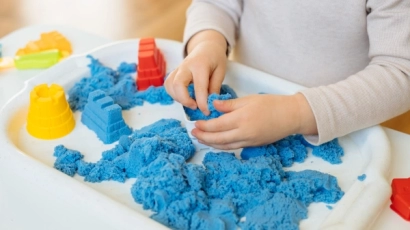
Not to mention, kinetic sand is an extremely beneficial form of sensory play. It introduces children to a unique tactile sensation that is neither fully solid nor liquid, so kids can spend hours stretching it, digging at it and scooping it up. All of this is extremely useful practice for developing your child’s fine motor skills. Beyond that, the soft, smooth texture of the sand is extremely soothing for children and can even help to promote better sleep, according to OrbRom’s article.
If you want to get creative, you can try burying small toys in the sand. Roleplay with your kids and let your budding archaeologists pretend to dig up long-lost fossils and clean them, all in a day’s work! Alternatively, you can also give your kids some sand molds to play with. Since kinetic sand is fairly similar to regular sand, it can be molded into different shapes and structures as well. It’s the perfect activity for a rainy day in, when your family can’t go to the beach!
Oobleck
If ‘oobleck’ sounds foreign to you, that’s alright! You’ve probably engaged with this form of sensory play for toddlers before, just that you weren’t aware of its name. Oobleck is actually just a simple mixture of cornstarch and water, in a 2 : 1 ratio. The end result is a syrupy substance that takes on both properties of solids and liquids. If you grab some in your fist, it’ll form a solid ball, but the moment you release the pressure, the oobleck resumes the form of a liquid and slips through your fingers.
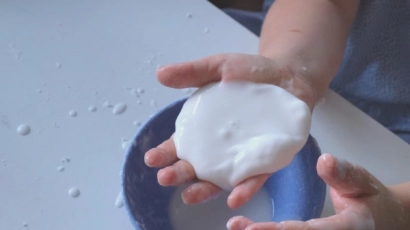
This sticky, viscous substance is tons of fun to play around with. Feel free to add a couple of drops of food colouring to the mixture so that you can get some interesting colours for your sensory play session with your toddler. Similar to kinetic sand, you can also toss in a couple of toys into the tub with the oobleck and let your kid go to town with it. They’re sure to enjoy experimenting with how different variations of pressures will result in oobleck assuming different forms!
However, do note that oobleck is pretty messy to play with. It’s bound to get on the floor and to stain shirts, especially when you have toddlers playing with it. So, make sure to be prepared for a round of thorough cleaning after this sensory play session with your toddler!
Also, take note that oobleck is ultimately a suspension – it’s cornstarch, mixed with water. If you let it sit long enough, the cornstarch will sink to the bottom of the mixture and leave a clear layer of water on top. Therefore, make sure to not dispose of your oobleck by pouring it down the drain – you’ll just end up with a hard lump of cornstarch clogging your sink. The best way to get rid of your oobleck is to pour it into a trash bag, then bin that.
Oatmeal
Last, but definitely not the least on this list of sensory play ideas for toddlers, is the humble oatmeal sensory bin. This is exactly what it sounds like: No fuss, no tricks. Just a large bin of uncooked oatmeal for your little one to experiment with.
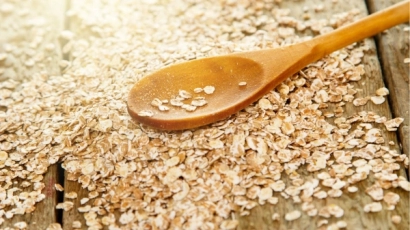
At first glance, this sensory play idea might seem a little plain compared to the others on the list. But trust us: The oatmeal sensory bin is hands down one of the best forms of sensory play that you can give to your toddler. The dry, fluffy texture of oatmeal is perfect for engaging tactile exploration. And the thing is, oatmeal is surprisingly versatile. Have your child practise pouring it into mugs and cups to practise their sense of balance and control. Or bury a few of their favourite toys within the oatmeal for them to dig up and play with.
Practically speaking, the oatmeal sensory bin is also super easy to clean up. You won’t even need to use soap and water – a simple sweep with a broom and dustpan will suffice. And if your child is the type who likes to chew on anything they can get their hands on? Well, oatmeal is perfectly taste-safe (though of course, we wouldn’t recommend allowing them to consume large amounts of uncooked oatmeal!)
The oatmeal sensory bin is a great way to introduce your kid to the concept of volume as well. As they’re scooping and pouring the oatmeal into different containers, they’re learning more about capacity and also improving their hand-eye coordination, as well as fine motor skills. It’s easy, effective, and promises your little one with an afternoon of entertainment!
And there we have it: The Best Sensory Play Ideas For Toddlers To Try Now! Have you tried any of these sensory play ideas for toddlers yet? How did it go? Did we miss out on any of your favourite sensory play ideas for your kid? Well, let us know in the comments below – we’d love to hear from you 💬👇