
Quick answer
Children with developmental delay or autism often toilet train later, and that’s okay. Start when your child shows readiness signs (staying dry for 1 to 2 hours, noticing a wet diaper, sitting for a short while). Use a picture routine, regular toilet times, the same words every time and lots of praise. Speak to your doctor about constipation, pain or no progress.
Your friend’s daughter was diaper-free at 2. Your son is 4 and still panics at the sight of the toilet bowl. Cue the guilt.
Please put the guilt down. Children with developmental delay or autism often learn toileting later, and in smaller steps. It’s not a race, and it’s not a reflection of your parenting.
Toilet training is a skill like any other. With the right timing, clear routines and a lot of patience, most children get there.
In this article
Is your child ready? Look for these signs
Toilet training readiness checklist
Tap each one that sounds like your child.
Three or more ticks? Your child may be ready to start. Fewer? Start with the “make the toilet familiar” step and check again in a few weeks.
Your child doesn’t need to talk to toilet train. Many children use a picture card or a sign to say “toilet”.
What about toilet training age? Many children are ready somewhere between 2 and 3, but children with autism or developmental delay often start later. Potty training a child with autism at age 4 or 5 is common and absolutely fine.
Why it can be harder for some children
- Body signals. Some children don’t notice the feeling of a full bladder until it’s too late.
- Sensory overload. The flush is loud, the seat is cold, the room echoes.
- Change is hard. Diapers are familiar. A new routine can feel scary.
- Many small steps. Pull down pants, sit, go, wipe, flush, wash hands. That’s a lot to remember.
- Constipation. It’s common, and painful poos make children avoid the toilet.
A step-by-step plan

- Make the toilet familiar. Read a toilet book, let your child sit on the seat fully clothed, and change diapers in the bathroom.
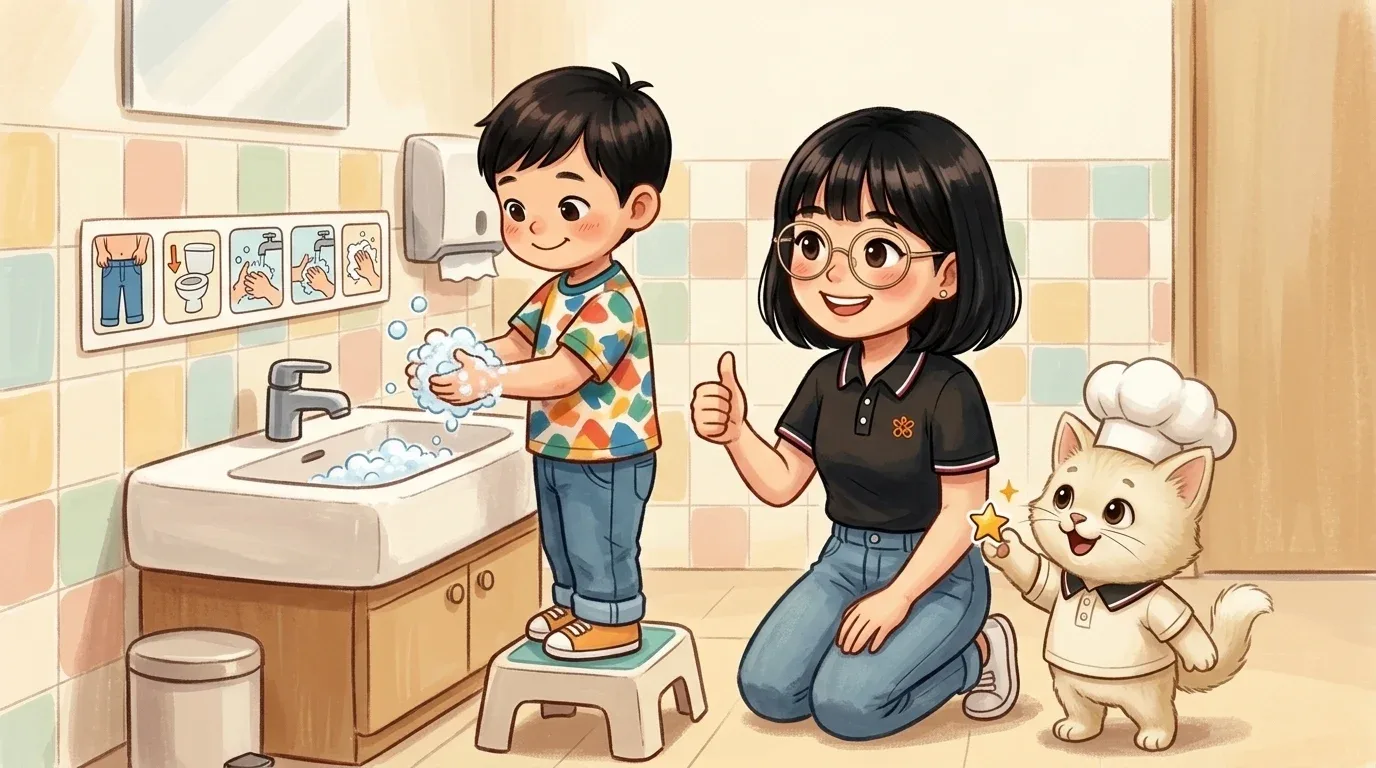
- Use a picture routine. Stick simple pictures on the wall: pants down, sit, wee, wipe, flush, pants up, wash hands.
- Keep the words the same. Choose one word, such as “toilet”, and everyone uses it, at home, school and with grandparents.
- Sit at regular times. After waking, after meals and before bath. Keep sits short (1 to 3 minutes) and relaxed.
- Make it comfortable. A child seat insert, a footstool so feet are flat, and ear defenders if the flush is too loud.
- Celebrate every step. Sitting is a win. Trying is a win. A small sticker or a favourite song works wonders.
- Switch to underwear in the day. When your child is having some success, so they can feel when they are wet.
Free toilet training chart
Screenshot this, or copy it onto paper and stick it on the toilet door. Tick each try, not just each success.
| Toilet time | Mon | Tue | Wed | Thu | Fri | Sat | Sun |
|---|---|---|---|---|---|---|---|
| After waking up | |||||||
| After breakfast | |||||||
| After lunch | |||||||
| After snack | |||||||
| Before bath | |||||||
| Before bed |
ONE teacher tip
Use the same 6 pictures at home and at the centre: pants down, sit, wee, wipe, flush, wash hands. Same pictures, same words, every time.
Read next
1. Toilet training support for children with special needs
2. “He Only Eats White Rice”: Picky Eater Checklist, When to Worry and What Actually Helps
3. Life Skills for Kids: What to Teach at Each Age (and How)
Free printable
Toilet Training Chart and Picture Routine
Readiness checklist, 7-step routine and a weekly chart to stick on the toilet door. Get the free PDF
When accidents happen
They will, and that’s part of learning. Stay calm and matter-of-fact: “Oops, wee goes in the toilet. Let’s change.” No scolding, no shaming. Then take your child to sit on the toilet briefly so the routine stays the same.
Speak to your doctor if your child is often constipated, has pain when going, was dry and suddenly isn’t, or hasn’t made progress after a few months of steady practice.
How ONE helps with toilet training
Self-help is one of our 7 Pillars of Growth, and toileting is one of the most important skills we work on. In class, our teachers follow the same picture routine and toilet times every day, and we agree the same words and steps with you so home and centre match.
With small groups (at most 1 teacher to 3 children), each child gets the time and patience they need. Progress is tracked weekly and shared in a monthly report, so you can see each step your child masters.
See how we support toilet training and delayed milestones, or WhatsApp us to talk about your child. Our early intervention programme in Eunos is for children aged 18 months to 6.
Free printable
6 cut-out picture cards for calmer, more predictable mornings. Get the free PDF
Questions parents ask
Is age 4 too late to potty train a child with autism?
No. Many children with autism learn toileting at 4, 5 or later. Start when you see readiness signs and go at your child’s pace.
At what age should a child with developmental delay be toilet trained?
There’s no fixed age. Many children with developmental delay or autism learn later than their peers. Start when you see readiness signs, and focus on progress, not age.
Can a non-verbal child be toilet trained?
Yes. Your child can use a picture card, a sign or a gesture to ask for the toilet.
Should I use rewards?
Small, immediate rewards (praise, stickers, a favourite song) help many children. Fade them out once the habit is strong.
What if my child is scared of the flush?
Let them leave the room before flushing, use ear defenders, or flush together once they are ready. Go at their pace.
Key takeaways
- Children with developmental delay often toilet train later, and that’s okay.
- Start when you see readiness signs, not by age.
- Picture routines, regular sits and the same words every time make it predictable.
- Stay calm about accidents and see a doctor about constipation, pain or no progress.
Sources: HealthyChildren.org (American Academy of Pediatrics), toilet training children with special needs.
Written by the ONE Intervention team. This article is general information, not a diagnosis or medical advice. If you are worried about your child, speak to your paediatrician or polyclinic doctor.